


Behind the Eye Mask: What EMDR Feels Like at GRIT
By: Michelle Madden, LPC, CADCII
Usually, by the time someone gets to GRIT, they've heard of EMDR. Maybe a therapist mentioned it. Maybe a coworker swears it changed their life. Maybe they saw it online and immediately thought, "Yeah, that's not for me."
Fair enough.
Before we get into it, it's important to understand that every EMDR therapist develops their own style. The foundation and protocol remain the same, but the way therapists prepare clients, conduct sessions, and create the treatment environment can vary quite a bit.
Over the years, I've developed my own style of conducting EMDR, particularly with first responders and military personnel. The foundation of EMDR remains the same, but the environment, pacing, and approach have evolved based on what I've seen work best with this population.
First responders and military members are trained to stay alert, read their environment, and anticipate what could happen next. Those skills are valuable on the job, but they can make it difficult to fully engage in the inward focus that EMDR often requires. Many clients find themselves scanning the room, noticing movement, or paying attention to what's happening around them instead of focusing on the work in front of them.
Because of that, I have adapted certain aspects of the experience to help clients reduce distractions, feel more comfortable, and stay engaged in the process.
Some clients jokingly refer to it as "EMDR with Madden." While the protocol remains EMDR, the experience is intentionally tailored to the culture, mindset, and unique needs of the people we serve at GRIT.
The first thing I tell clients is that we don't throw them into EMDR on day one.
Most people have spent years surviving. A week isn't going to make or break anything.
I want clients to settle in first. Learn the routine. Meet the staff. Get comfortable. Take a breath.
Once they're ready, we start talking about EMDR, what it is, how it works, and what their role is in the process. One of the biggest misconceptions is that EMDR is only for trauma.
It isn't.
 We've used EMDR to help clients work through grief, anxiety, depression, phobias, addiction, shame, difficult memories, and negative beliefs they've carried for years. If it's causing distress and keeping someone stuck, it's probably worth exploring.
During the introduction, clients start building a timeline. Not because we're going to work through life in chronological order, but because it helps identify experiences that still carry emotional weight. Those experiences may come from childhood, a difficult call last month, grief, a relationship, or even fears about the future. EMDR doesn't care where the distress comes from. We just need a place to start.
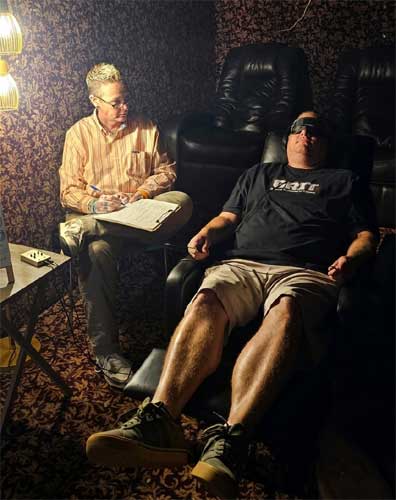
One thing that's a little different about how I conduct EMDR is the environment. To help clients fully immerse themselves in the process, I primarily use audio and tactile bilateral stimulation. Clients wear a sleep mask, listen to alternating tones through headphones, and hold tactile tappers that gently vibrate from one side to the other. The goal isn't to make the experience uncomfortable. It's actually the opposite. By reducing outside distractions, clients are often able to focus more deeply on what's happening internally.
Sessions typically take place in our theater room, which provides a quiet, controlled environment where clients can sit upright or recline; whatever feels most comfortable. The room can be darkened, distractions are minimized, and clients are given the opportunity to fully settle into the process.
One of the biggest advantages we have at GRIT is time. In outpatient therapy, sessions often have to end because the clock says so. At GRIT, we have the flexibility to keep working when a client is making progress. We don't stop because a timer goes off. We stop because the work for that day is complete.
 Just as importantly, I don't believe in forcing a client to go somewhere they're not ready to go. EMDR is challenging enough without feeling pushed. My job isn't to drag someone through the process. My job is to walk beside them, help them feel safe enough to do the work, and trust that their brain will go where it needs to go when it's ready. Ironically, I've found that when clients know they have permission to slow down, take a breath, or even throw up the stop sign, they're often able to go much farther than they ever thought possible.
Most EMDR sessions start with a target memory or event and a negative belief attached to it.
Something like:
"I'm not safe."
"I should have done more."
"I'm not enough."
"I failed."
 As processing unfolds, those beliefs often begin to shift. That shift is where the work happens.
Not because we're forcing positive thinking, but because the brain is finally processing information in a way it couldn't before.
Another thing I tell every client is that EMDR doesn't necessarily stop when the session ends.
You may have dreams. You may remember things you haven't thought about in years.
You may notice emotions, body sensations, thoughts, or insights popping up later that day.
That's normal.
Your brain is continuing to process. At the end of the day, EMDR isn't about erasing memories.
It's about taking experiences that still have a grip on you and helping your brain put them where they belong.
The memory stays. The weight doesn't have to.
Magnolia Meadows Residential Treatment Facility provides Treatment exclusive for First Responders & Veterans battling Trauma, Mental Health Conditions and Co-Occurring Disorders, creating a healing atmosphere for recovery, and instill a confident hope that better days are ahead.
Reach out to learn more or speak with an admissions specialist.
855-644-7500
[email protected]