


The Trauma Before the Trauma
By: Magnolia Meadows
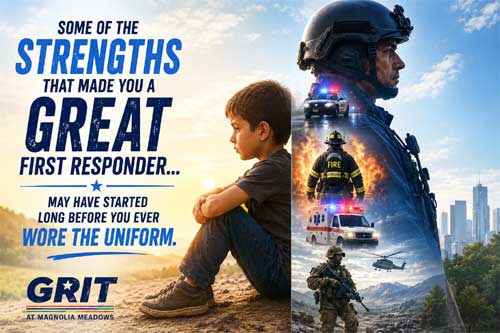 Why do so many first responders and military members choose careers that require them to run toward danger while everyone else is running away?
It's a question researchers have explored for years, and the answer is far more complex than adrenaline or simply wanting to help people.
For many, the desire to serve begins long before the academy, the firehouse, or boot camp.
Research has found that a significant number of first responders and military members report experiencing Adverse Childhood Experiences (ACEs): events such as abuse, neglect, household dysfunction, addiction, domestic violence, or growing up in environments where safety and stability were never guaranteed. Others describe childhoods where they became the protector, the peacekeeper, or the responsible one long before adulthood.
To be clear, not everyone who serves has experienced childhood trauma. Many come from healthy, supportive families and simply feel called to serve. For others, early life experiences helped shape strengths that later became invaluable on the job.
Children raised in unpredictable environments often become exceptionally observant. They learn to read people, recognize danger before others do, and stay prepared for the next crisis. Those same survival skills often become remarkable professional strengths.
For many, those instincts existed long before the academy ever gave them a name.
Many first responders also describe becoming caregivers early in life; looking after siblings, trying to keep peace within the home, or feeling responsible for everyone else's emotions. Years later, protecting others doesn't feel unfamiliar. It feels like purpose. The challenge is that the same qualities that make someone exceptional on the job can become obstacles once the shift is over.
Hypervigilance becomes difficulty relaxing. Responsibility becomes an inability to ask for help. Strength becomes emotional suppression. Control becomes perfectionism. The constant need to protect everyone else often leaves very little room to care for yourself. Over time, occupational trauma begins stacking on top of whatever came before it. That's why treatment isn't always about "the worst call." It's about understanding why certain calls hit differently and why one person's tragedy feels deeply personal, or why an interaction with a child, a domestic violence victim, or a grieving family continues to linger long after the shift ends. Sometimes it isn't the call itself. Sometimes it's what the call touches. The job doesn't create every wound. Sometimes it simply shines a light on wounds that have been there all along.At GRIT, we've found that many first responders and military members aren't carrying one type of trauma; they're carrying layers of it. Childhood trauma, occupational trauma, relationship trauma, grief, betrayal, moral injury, cumulative stress, and critical incidents often become intertwined. Understanding where those layers intersect is one of the most important parts of healing. That's why treatment at GRIT is never one-size-fits-all. We don't treat diagnoses, we treat people.
Our clinicians utilize a variety of evidence-based trauma therapies, including Eye Movement Desensitization and Reprocessing (EMDR), Cognitive Processing Therapy (CPT), Trauma-Focused Cognitive Behavioral Therapy (TF-CBT), Dialectical Behavior Therapy (DBT), Acceptance and Commitment Therapy (ACT), mindfulness-based interventions, experiential therapies, psychoeducation, and individual, group, and family therapy. Every treatment plan is individualized because no two trauma stories and no two first responders or service members are the same.
Healing isn't about blaming childhood. It's about understanding it. When we recognize where some of our greatest strengths came from, we can also begin to understand why some of our greatest struggles continue to follow us.
At GRIT, we often tell clients that trauma doesn't always begin with the badge. Sometimes the uniform didn't create the survival skills. It simply gave them a place to keep working. Recovery isn't about changing who you are. It's about learning when those survival skills are still needed and when it's finally safe to put them down. Whether your trauma began in childhood, during military service, on the job, or through years of cumulative exposure to other people's worst days, healing is possible.
You spent your career protecting others.
You deserve the opportunity to heal yourself.
Magnolia Meadows Residential Treatment Facility provides Treatment exclusive for First Responders & Veterans battling Trauma, Mental Health Conditions and Co-Occurring Disorders, creating a healing atmosphere for recovery, and instill a confident hope that better days are ahead.
Reach out to learn more or speak with an admissions specialist.
855-644-7500
[email protected]