

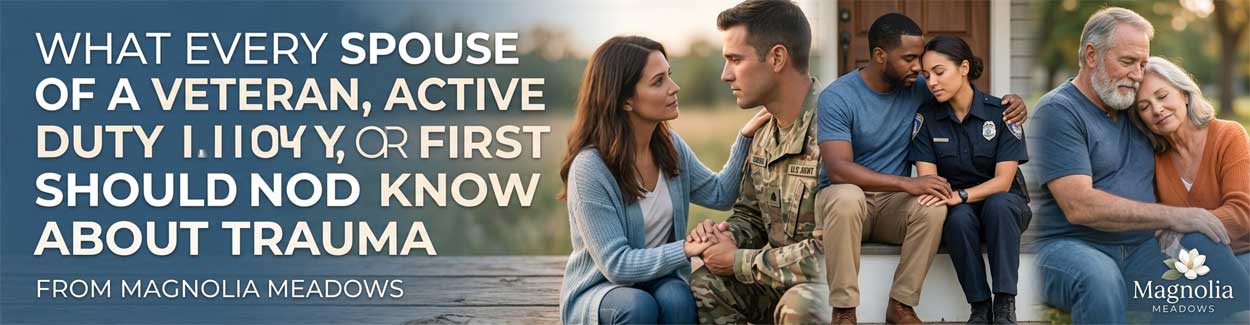
What Every Spouse of a Veteran, Active-Duty Military or First Responder Should Know About Trauma
 When you love a veteran, active-duty service member, police officer, firefighter, paramedic, or EMT, you understand that the job comes with sacrifices. You expect the long shifts, the missed holidays, the interrupted family plans, and the stress that comes with a life dedicated to serving others.
What many spouses don't expect is how those experiences can follow their loved one home.
For some families, the change is obvious. For others, it happens so gradually that it's difficult to recognize. The person you married is still there, but something feels different. They may seem more withdrawn, more irritable, or less interested in activities they once enjoyed. Conversations become shorter. Emotional connection becomes harder to find. You may find yourself wondering what happened and, more importantly, whether there's anything you can do to help.
The truth is that many of these changes may have less to do with the relationship itself and more to do with the invisible impact of trauma.
Trauma Doesn't Always Look the Way People Expect
When people hear the word "trauma," they often think about dramatic scenes portrayed in movies or television. They imagine flashbacks, panic attacks, or someone who is clearly struggling to function.
In reality, trauma often looks much different.
For veterans and first responders, trauma can develop not only from a single event but from years of exposure to human suffering, loss, danger, and stress. A police officer may spend years responding to tragedies most people never witness. A firefighter may see devastating loss in the course of a single shift. A combat veteran may carry memories and experiences that are difficult to explain to anyone who hasn't lived them.
Over time, these experiences can change the way a person thinks, feels, and interacts with the world around them.
Instead of obvious symptoms, spouses often notice subtle changes. Their loved one sleeps poorly. They become easily irritated. They avoid crowds. They seem emotionally disconnected. They work constantly because staying busy feels easier than sitting with their thoughts. Some begin withdrawing from family and friends without fully understanding why.
These behaviors are often mistaken for personality changes when they may actually be signs that someone is carrying far more than they let on.
Wondering what treatment is really like?
Our Alumni Peer Support Program gives you the opportunity to speak with
Magnolia Meadows alumni who have experienced the journey firsthand.
Learn what to expect before admission, what daily life in treatment is
like, and how recovery continues after discharge. Through honest,
real-life conversations, alumni provide insight, encouragement, and hope
to help you feel more confident about taking the next step toward healing.
You will speak directly with an alumnus or alumna in the same field who
can provide honest, transparent feedback about their experience in
treatment and at Magnolia Meadows.
Talk to a Alumni
One of the most frustrating experiences for spouses is feeling shut out by the person they love.
Many family members ask the same question: "Why won't they just tell me what's wrong?"
The answer often lies in the culture of military and first responder professions. These are careers that demand resilience, composure, and the ability to function under extraordinary pressure. From early in their careers, many service members and first responders learn to push difficult emotions aside so they can focus on the mission in front of them.
That skill can be invaluable on the job.
At home, however, it can become a barrier to connection.
Many veterans and first responders struggle to discuss what they've experienced because they don't want to burden their families. Others worry they won't be understood. Some have spent so many years suppressing their emotions that they genuinely have difficulty identifying what they're feeling.
As a result, spouses may repeatedly hear, "I'm fine," even when it's clear that something isn't right.
This can feel hurtful, but it is rarely about a lack of trust or love. More often, it reflects someone doing their best to manage pain in the only way they've ever known.
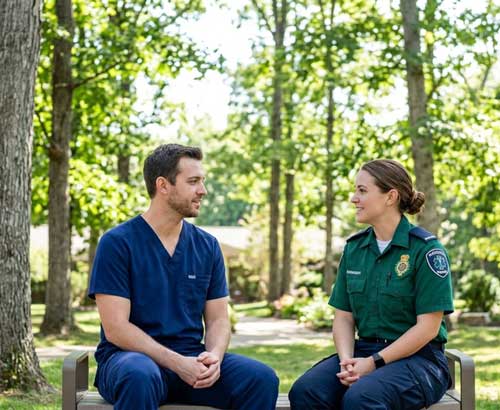 When Trauma Comes Home
Trauma rarely affects only the individual carrying it. Its impact often extends to the entire family.
Many spouses describe feeling lonely despite being in a committed relationship. They miss the connection they once shared. They begin walking on eggshells to avoid conflict or become accustomed to a level of emotional distance that slowly becomes the new normal.
Children can feel the effects as well. They may notice that mom or dad is less engaged, more easily frustrated, or less emotionally available than before.
Over time, family members start adapting to the trauma, even if they don't recognize it as trauma. Conversations are avoided. Plans are adjusted. Needs go unspoken. Everyone learns how to navigate around the struggle rather than address it directly.
Unfortunately, this often creates even greater disconnection.
The veteran or first responder feels misunderstood, while the spouse feels shut out. Both care deeply about each other, but neither feels fully seen or heard.
Understanding Hypervigilance
One of the most common yet misunderstood effects of trauma is hypervigilance.
For individuals who have spent years working in dangerous environments, being alert is not a habit. It's a survival skill.
The police officer who constantly scans a room, the veteran who prefers sitting with their back against a wall, or the firefighter who has difficulty relaxing during family vacations isn't necessarily choosing those behaviors. Their nervous system has learned to remain prepared for potential danger, even when they're safe.
To spouses, this often looks like distraction, restlessness, or an inability to be present.
In reality, their brain may still be operating as though a threat is just around the corner.
Understanding this doesn't solve the problem, but it can help families view these behaviors through a lens of compassion rather than frustration.
How Spouses Can Help
One of the hardest truths for spouses to accept is that they cannot heal trauma for someone else.
What they can do is create an environment where healing feels possible.
Often, that starts by approaching conversations with curiosity instead of criticism. Rather than focusing on what a loved one is doing wrong, it can be more effective to talk about what you've observed and how it has affected you.
Simple statements such as, "I've noticed you seem overwhelmed lately," or "I'm worried about you," often create less defensiveness than demands for change.
It's also important to remember that meaningful conversations rarely happen all at once. Trust and vulnerability are often rebuilt through many small moments rather than one life-changing discussion.
Sometimes the most powerful message a spouse can communicate is simply, "You don't have to carry this alone."
Don't Forget About Yourself
In relationships affected by trauma, spouses often become so focused on helping their loved one that they neglect their own needs.
The reality is that supporting someone through emotional struggles can be exhausting. Feelings of frustration, sadness, helplessness, and isolation are common. Acknowledging those emotions does not make someone unsupportive. It makes them human.
Seeking support from trusted friends, therapists, support groups, or faith communities can provide spouses with a safe place to process their own experiences.
Taking care of yourself is not selfish. It is one of the most important things you can do for both yourself and your family.
Hope Is Possible
Perhaps the most important thing for spouses to remember is that trauma is treatable and healing is possible.
Every day, veterans and first responders take steps toward recovery. They learn healthier ways to process their experiences, reconnect with their families, improve communication, and regain a sense of peace they may not have felt in years.
The journey is not always easy, but it is possible.
If you're the spouse of a veteran, active-duty service member, or first responder, know that the struggles you're seeing are not necessarily signs of a broken relationship or a lack of love. Often, they are signs of an invisible wound that deserves the same attention and care as any physical injury.
Understanding trauma is one of the first steps toward healing. And for many families, that understanding becomes the foundation for rebuilding connection, restoring hope, and moving forward together.
Magnolia Meadows Residential Treatment Facility provides Treatment exclusive for First Responders & Veterans battling Trauma, Mental Health Conditions and Co-Occurring Disorders, creating a healing atmosphere for recovery, and instill a confident hope that better days are ahead.
Reach out to learn more or speak with an admissions specialist.
855-644-7500
[email protected]