


When the Past Shows Up in the Present
By: Magnolia Meadows
Unresolved childhood trauma doesn't always look like trauma. Sometimes it looks like independence. Control. Perfectionism. Dark humor. Staying busy. Never asking for help. Being the person everyone else can count on. It can look like an incredibly capable adult who functions well under pressure and has built a successful career taking care of other people.
For years, those patterns may work. Then something changes.
The accumulated weight of calls, deployments, loss, moral injury, relationships, family stress, substance use, poor sleep, or another critical incident begins pushing against something that was already there. What once helped someone survive and succeed may start showing up differently: as anger, anxiety, isolation, hypervigilance, emotional numbness, relationship problems, substance use, or an inability to shut their mind off when the shift is over.
The presenting problem may be what finally brings someone to treatment. It isn't always where the story started.
That distinction matters at GRIT. When childhood trauma is part of someone's history, we don't automatically assume it explains everything happening today. We also don't ignore it simply because the client came to us as a firefighter, police officer, medic, dispatcher, corrections professional, veteran, or active-duty service member. We look at how the pieces connect.
Sometimes occupational trauma is the primary issue. Sometimes earlier experiences are still influencing how someone responds to stress, relationships, vulnerability, control, trust, or perceived danger. And sometimes decades of experiences have become so intertwined that treating one layer without understanding the others only gets us so far.
Before Processing Comes Safety
Trauma treatment isn't about handing somebody a shovel on day one and telling them to start digging through the worst experiences of their life. Before deeper processing begins, our clinical team works with clients on recognizing triggers, understanding their physical and emotional responses, grounding, emotional regulation, distress tolerance, communication, and learning what is actually happening when their nervous system goes into survival mode. That foundation matters.
For someone who has spent decades surviving by shutting things down, compartmentalizing, staying busy, or handling everything themselves, "talk about your feelings" isn't much of a treatment plan. We give them practical tools first. Then we can begin doing the deeper work.
EMDR: Connecting What Happened Then With What's Happening Now
EMDR is one of the trauma-processing modalities we use at GRIT, and it can be particularly valuable when earlier experiences continue influencing present-day reactions. EMDR isn't about erasing a memory. The person still knows what happened. The goal is to help the brain process traumatic experiences differently so those memories no longer carry the same emotional and physiological intensity. EMDR is an evidence-based treatment for PTSD, and research has also supported its use with adults carrying trauma from childhood.
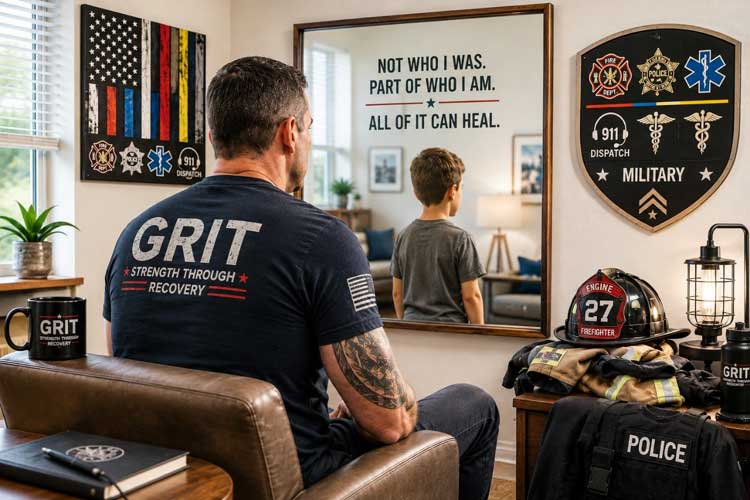
For first responders and military personnel, that work can uncover connections that aren't always obvious at first. The anger may not only be anger. The need for control may have existed long before the job. The inability to trust someone may not have started with the department. The reaction to a particular call may be connected to something that happened years before the uniform. Sometimes the realization is powerful: This isn't only about that call. That call touched something that was already there. Understanding that doesn't minimize what happened on the job. It gives us a more complete picture of why the impact may have been so significant.
 EMDR Isn't the Whole Treatment Plan
This part is important. GRIT isn't an EMDR program. We're a treatment program that uses EMDR when clinically appropriate. Trauma doesn't exist in isolation, so neither should treatment. Depending on the individual, treatment may incorporate Cognitive Processing Therapy (CPT), trauma-focused cognitive approaches, DBT-based skills, mindfulness, motivational work, relapse prevention, individual and group therapy, experiential work, family involvement, and medication management. CPT and other cognitive approaches can help identify and challenge beliefs that often become attached to trauma:
I should have stopped it. I should have known. I can't trust anyone. If I'm not in control, something bad will happen. Needing somebody makes me weak.
DBT-informed skills help with emotional regulation and distress tolerance. Learning how to experience an emotion without immediately reacting to it, avoiding it, numbing it, or allowing it to control what happens next.
Experiential work gives clients opportunities to practice those skills outside the therapy room.
And family involvement helps the people waiting at home understand what is changing, what may still be difficult, and how to support progress without removing accountability or healthy boundaries.
There isn't one modality that fixes everybody. Effective trauma treatment means determining what the individual actually needs rather than forcing every person through the same process.
The Job Can Complicate the Work
There is another layer when we're treating first responders and military personnel. Some of the very things we're asking someone to examine in treatment may also be things that have helped them survive professionally. Hypervigilance can be useful when you're clearing a building.
Compartmentalization can help you finish a shift after a horrific call. Remaining emotionally controlled can help you make decisions when everyone around you is panicking. Independence and self-reliance are valued in these cultures. Those aren't automatically problems.
The question becomes: Can you turn them off when you don't need them?
Hypervigilance that protects you at work can create exhaustion and anxiety at home. Compartmentalization that gets you through a call can create distance from your spouse and children. Self-reliance can become isolation. Control can become rigidity. And being the person everybody else depends on can make it incredibly difficult to admit when you're the one who needs help.
The Goal Isn't to Change Who They Are
We're not trying to take away the characteristics that made someone a good firefighter, police officer, medic, dispatcher, corrections professional, or service member. We don't want to remove their independence, situational awareness, ability to function under pressure, or willingness to take care of other people. We're helping them understand when those strengths became survival mechanisms and when those survival mechanisms started costing them something. Maybe hypervigilance kept you alive on deployment. It doesn't necessarily need to run your house. Maybe compartmentalization helped you finish the shift after a horrific call.
It doesn't necessarily need to determine how you communicate with your spouse. Maybe handling everything yourself got you through childhood. It doesn't mean you have to spend the rest of your life doing it alone.
That's the work.
At GRIT, we're not interested only in treating the symptom or incident that finally brought someone through our doors. When earlier trauma is clinically relevant, we're willing to look at that too; not to blame the past, but to understand how it may still be influencing the present.
Because sometimes healing what is happening today requires understanding what we've been carrying forward all along.
Magnolia Meadows Residential Treatment Facility provides Treatment exclusive for First Responders & Veterans battling Trauma, Mental Health Conditions and Co-Occurring Disorders, creating a healing atmosphere for recovery, and instill a confident hope that better days are ahead.
Reach out to learn more or speak with an admissions specialist.
855-644-7500
[email protected]