

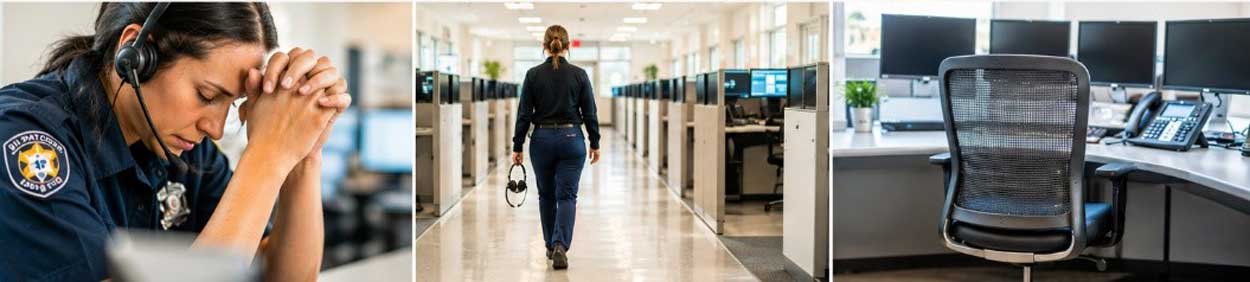
When the Call Ends, the Impact Doesn't
When we talk about first responder mental health, we usually picture the people arriving on scene: the firefighter, police officer, paramedic, or EMT. But before any of them get there, someone answers the call. Dispatchers and public safety telecommunicators hear people during some of the worst moments of their lives. They hear the screaming, the panic, the gunshots, the last breaths, the child who isn't breathing, the officer calling for help, and the family member realizing someone they love is gone.
They don't see the scene. Sometimes that's part of what makes the job so difficult. They have to build the scene in their head, make decisions with limited information, keep the caller focused, send the right resources, protect responders, document what's happening, and remain calm...all while having very little control over what happens on the other end of the phone. Then the call disconnects. And another line lights up.
The First First Responder We Don't Always See
Dispatch has historically occupied an unusual place within first responder culture. They're part of nearly every critical incident, but they're rarely standing in the photographs afterward. That invisibility can extend to mental health. Research is beginning to show just how significant the psychological burden can be. A recent systematic review of emergency telecommunicators estimated that during routine practice, 12.4% reported suicidal ideation, 5.7% reported making a suicide plan, and 0.7% reported a suicide attempt. The same review found substantial rates of depression, alcohol misuse, secondary traumatic stress, and acute stress disorder. A separate meta-analysis involving 7,759 call-handlers and dispatchers across nine countries estimated depression at 28.2%, PTSD at 17.8%, anxiety at 17.2%, and hazardous drinking at 17.8%.
Those numbers deserve our attention. But there is another part of the story that may be even more important: We probably don't know the whole story.
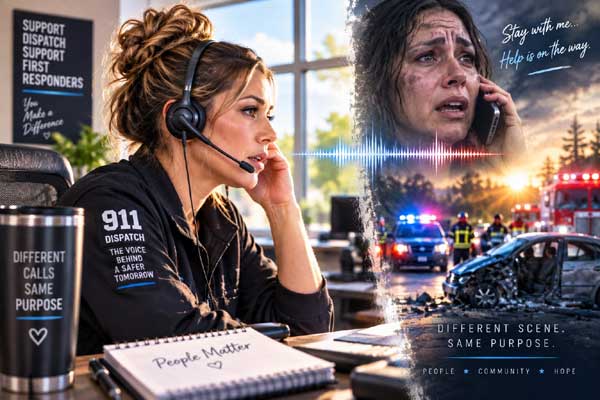 The Numbers We Don't See
Suicide attempts among public safety communicators remain poorly documented, and researchers specifically describe them as rarely reported and under-reported in the available literature. Even those numbers don't tell the whole story. The reality is, some of the people struggling the most never say anything at all. Fear of judgment, career consequences, or simply being seen differently can keep someone quiet and that means their struggle may never show up in the statistics. That matters in a culture where being able to handle the next call is part of the job.
Dispatchers may worry about being judged by coworkers, being seen as unable to do the job, becoming a burden on an already short-staffed center, or having their fitness for duty questioned. Research on public safety communicators identifies stigma, emotional suppression, organizational isolation, shift work, indirect trauma exposure, and inadequate organizational support among the factors contributing to distress and limiting help-seeking. Sometimes it isn't a single catastrophic call. It's accumulation. Ten years of voices. Twenty years of other people's worst days. Calls involving children. Suicides. Domestic violence. Officer-involved shootings. Fatal wrecks. Line-of-duty deaths. Listening helplessly while something happens before responders can arrive. You can hang up a phone. That doesn't mean your brain hangs up with it.
When "I'm Fine" Deserves Another Question
Not everyone experiencing occupational stress is suicidal, and not every change in behavior means someone is in crisis. But we need to get better at noticing when someone isn't acting like themselves. In a communications center, that might look like someone becoming increasingly withdrawn or emotionally flat. Maybe the dispatcher who was always involved with the shift suddenly stops talking. Their patience with callers disappears. Their dark humor changes. They're calling out more, sleeping less, drinking more, or avoiding particular types of calls.
Maybe they're replaying calls long after their shift ends. Maybe they're increasingly angry, reckless, hopeless, or disconnected at home. Or maybe they start making comments that are easy to dismiss in first responder culture:
"I'm done." "I can't keep doing this." "Everybody would be better off without me."
Sometimes dark humor is just dark humor. Sometimes it isn't.
The answer isn't to panic every time someone has a bad day. It's to know your people well enough to recognize when something has changed and be willing to ask the second question.
"How are you?" "Fine." "No, really. How are you?"
Dispatch Experiences Trauma Differently
One of the mistakes we make is assuming trauma requires physically witnessing an event. It doesn't. Public safety communicators experience repeated indirect exposure to traumatic events while simultaneously carrying enormous responsibility for the outcome. Research increasingly recognizes traumatic narratives, high-stakes decision-making, emotional suppression, chronic shift work, and organizational stress as meaningful occupational risks for this workforce.
There can also be a lack of closure. The officer knows how the call ended. The medic treated the patient. The firefighter saw what happened. The dispatcher may hear screaming, send everybody they can, and then have to disconnect because another emergency is waiting. They may never know what happened next. So the brain fills in the blanks.
We Have to Make Room for Dispatch
September is Suicide Prevention Month, and prevention cannot only mean giving someone a hotline number after they've reached the edge. Prevention starts much earlier. It means communications centers where asking for help isn't automatically interpreted as being unable to do the job. Supervisors who understand trauma exposure. Peer support that includes dispatch; not as an afterthought, but as part of the team. Access to clinicians who understand first responder culture. Debriefing after critical incidents. Departments recognizing cumulative trauma instead of waiting for one dramatic event. It means the rest of the first responder community remembering who was on the other end of the radio. Dispatch belongs in the conversation.
To the Voice on the Other End
At GRIT, when we say we treat first responders, we mean dispatch too. You don't need bunker gear, a patrol car, an ambulance, or combat boots for your experiences to count. You heard it.
You carried it. You made decisions while somebody else's world was falling apart. You helped get people home. And if years of doing that have started following you home, affecting your sleep, your relationships, your drinking, your ability to shut your brain off, or changing how you see yourself and the world around you, that deserves attention.
You don't have to wait until you're suicidal. You don't have to wait until your marriage is falling apart. You don't have to wait until you can't work. And you certainly don't have to prove that what you've experienced was "bad enough." The person who answers everyone else's call is allowed to make one too. That's a conversation worth having...not just during September, but all year long.
Magnolia Meadows Residential Treatment Facility provides Treatment exclusive for First Responders & Veterans battling Trauma, Mental Health Conditions and Co-Occurring Disorders, creating a healing atmosphere for recovery, and instill a confident hope that better days are ahead.
Reach out to learn more or speak with an admissions specialist.
855-644-7500
[email protected]